

Published by Medical Muse, a medical school admissions consulting company that offers personalized support to help medical school applicants successfully navigate the competitive admissions landscape.
Table of Contents
Writing a personal statement for medical school can feel utterly overwhelming. How do you squeeze your entire life’s dedication, clinical hours, and your fundamental human “why” into a rigid character limit?
Many pre-med students paralyze themselves trying to draft a flawless masterpiece on their first attempt because they simply don’t know how to start a medical school personal statement without freezing up. The reality is that writing a highly competitive essay often requires transitioning away from staring at a blank screen and moving toward an execution-based, multi-phase system.
By breaking your writing cycle down into an operational timeline, you can eliminate the emotional stress of drafting and build a cohesive narrative that admissions committees will remember.
The Executive Summary Matrix
Consider using this structural matrix to align your writing process with standard AMCAS and AACOMAS application expectations:
| Application Component | Target Character Limit | Recommended Draft Waves | Optimal Completion Window |
| AMCAS Personal Statement | 5,300 characters (including spaces) | 4 to 6 comprehensive drafts | 12 to 16 weeks before submission |
| AACOMAS Personal Statement | 5,300 characters (including spaces) | 4 to 6 comprehensive drafts | 12 to 16 weeks before submission |
| Work and Activities Sections | 700 characters per entry | 2 to 3 refinement passes | 6 to 8 weeks before submission |
What is the Best Timeline for Writing Your Personal Statement?
The Takeaway
A great strategy is to begin brainstorming your personal statement at least 4 to 6 months before your application cycle opens. For most applicants, launching your initial planning phase in December or January is highly recommended to ensure you have plenty of time for an error-free, multi-draft submission by June.
Master the Med School Personal Statement Timeline
Your writing strategy shouldn’t happen overnight. To maintain sustainable output, consider dividing your efforts across a dedicated 4-phase calendar:
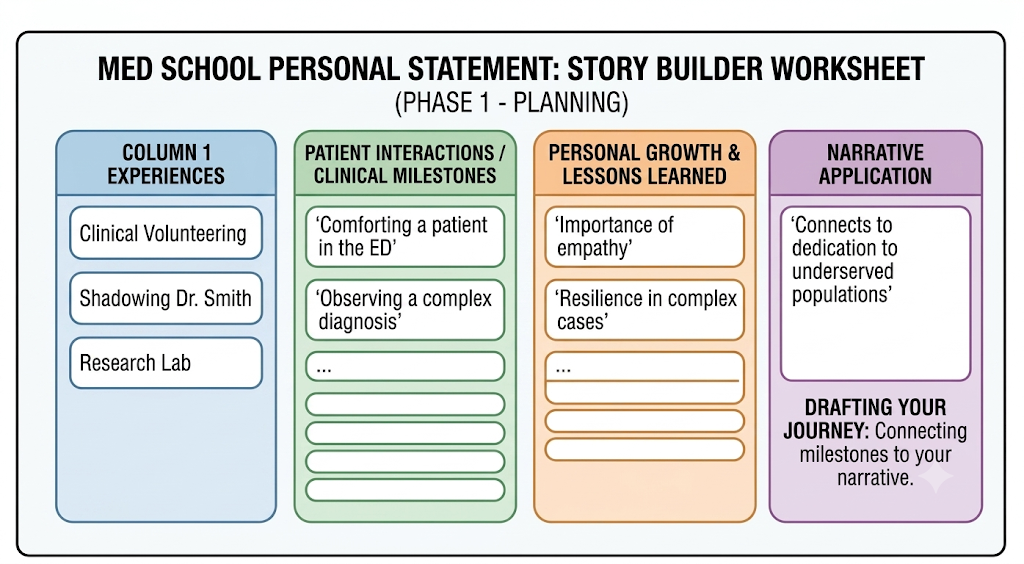
Phase 1: Planning (Weeks 1-4)
Before typing your first sentence, take the time to map out your conceptual foundation. Use our story builder to extract your defining clinical milestones, research background, and patient care interactions.
Phase 2: Drafting (Weeks 5-8)
Try connecting your raw clinical milestones into a cohesive, logical trajectory. Instead of writing a disjointed summary of your resume, look for the underlying theme that ties your experiences together. If you hit a creative freeze point, it helps to return immediately to your core thesis.
Phase 3: Revising (Weeks 9-12)

Consider refining your draft to balance clinical accuracy with your natural, human voice. While you want to accurately describe your clinical exposures, overcomplicating your sentences with dense medical terminology can obscure your unique voice.
Phase 4: Final Editing (Weeks 13-16)
Step away from your final draft for 72 hours before executing a structural, microscopic proofread. Eliminate grammatical errors, awkward transitions, and structural filler.
What is the Recommended Medical School Personal Statement Length?
The maximum length for an AMCAS medical school personal statement is 5,300 characters including spaces, which is approximately 750 to 900 words. Because the application portal prevents you from typing past this ceiling, focusing on concise, meaningful paragraph structures is your best strategy for success.
Maximize Your Character Allocation Real Estate
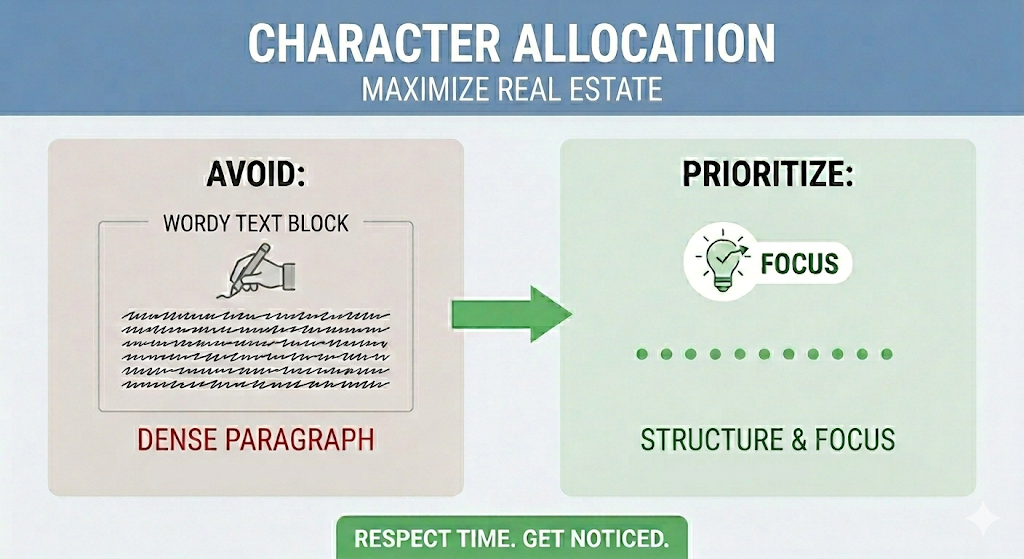
Admissions committees read thousands of essays every single cycle. In fact, historical data from the Association of American Medical Colleges shows that the average pre-med student submits 18 separate applications, resulting in individual medical schools receiving thousands of essays to screen. To keep an admissions officer fully engaged, it is important to respect their time by keeping your writing focused and scannable.
| Essay Structural Element | Target Paragraph Count | Core Strategic Function | Suggested Character Budget |
| The Hook/Introduction | 1 Paragraph | Capture attention with a high-stakes clinical or personal vignette; establish your thesis. | 800 – 1,000 characters |
| Body Paragraphs (Clinical/Research) | 2–3 Paragraphs | Show, don’t tell. Detail your patient-facing experiences and lessons learned. | 2,500 – 3,000 characters |
| The Conclusion | 1 Short Paragraph | Tie your experiences back to your future goals as a physician; deliver a memorable wrap-up. | ~800 characters |
Should You Use Professional Personal Statement Guidance Services?
Enlisting professional personal statement guidance services provides objective, high-level critiques that peers and family cannot reliably offer. Professional feedback ensures your unique journey is highlighted with maximum clarity while aligning with standard medical application expectations. Using professional guidance to help draft your personal statement ensures that your unique voice will shine through.
Secure Expert Eyes for Your Final Pass
Even top-tier writers struggle with blind spots. While sharing drafts with trusted peers and undergraduate mentors is helpful, completing multiple rounds of professional evaluation helps ensure your voice remains authoritative and authentic.
According to data compiled by the Association of American Medical Colleges (AAMC), the medical school acceptance rate continues to hover tightly around 41-43% nationally. Because the admissions process is incredibly competitive, a strategic structural review can be an effective way to help your essay stand out and secure an interview invitation.
Launch Your Journey with Medical Muse
Your personal statement is the single most valuable asset on your application to reveal the human being behind your MCAT scores and GPA. Don’t let a weak opening hook or poor narrative pacing compromise lots of hard work.
Medical Muse is a Medical Consulting company that offers personalized packages to help medical school applicants build flawless application portfolios. Our tailored Personal Statement Packages provide one-on-one strategy sessions, narrative design, and line-by-line editorial polishing.
Ready to transform your rough draft into an unforgettable medical narrative? Connect with the Medical Muse team to secure your admissions edge.
Frequently Asked Questions
Can I reuse my personal statement if I am a re-applicant?
A great strategy is to completely restructure or heavily rewrite your essay. Medical school admissions committees often compare your new application directly against your previous files. Refreshing your narrative is highly effective because it showcases your recent clinical growth, updated self-reflection, and continuous dedication over the intervening year.
Is it acceptable to discuss childhood experiences in the essay?
Consider focusing on childhood events only if they serve as a brief introduction to your journey. Your best strategy is to dedicate the majority of your paragraph space to recent, university-level clinical exposures and adult milestones, as these most accurately demonstrate your current readiness for medical school.
How many people should edit my personal statement?
We recommend limiting your core review team to two or three trusted individuals, including only one professional advisor. Gathering too many conflicting opinions can inadvertently dilute your unique perspective, which often leads to a fragmented draft that loses your voice.