Applying to Medical School and Residency are significant milestones for aspiring physicians. While both applications showcase your academic achievements and experiences, residency programs evaluate applicants through a much more specialized lens. Understanding these differences from the start allows you to build stronger applications, avoid common mistakes, and prepare strategically for residency interviews.
Below are some of the biggest differences between the medical school application process and residency application process.
AMCAS vs. ERAS: Understanding the Application System
One of the first major differences between AMCAS and ERAS is the application platform itself. Medical School applicants submit their application through AMCAS, TMDSAS, or AACOMAS, while Residency applicants use the Electronic Residency Application Service (ERAS).
Although all these systems collect transcripts, personal information, experiences, and letters of recommendation, ERAS is specifically designed for residency programs. In ERAS, you must assign letters of recommendation to individual residency programs, tailor your application to their chosen specialty, and answer specific supplemental essay questions.
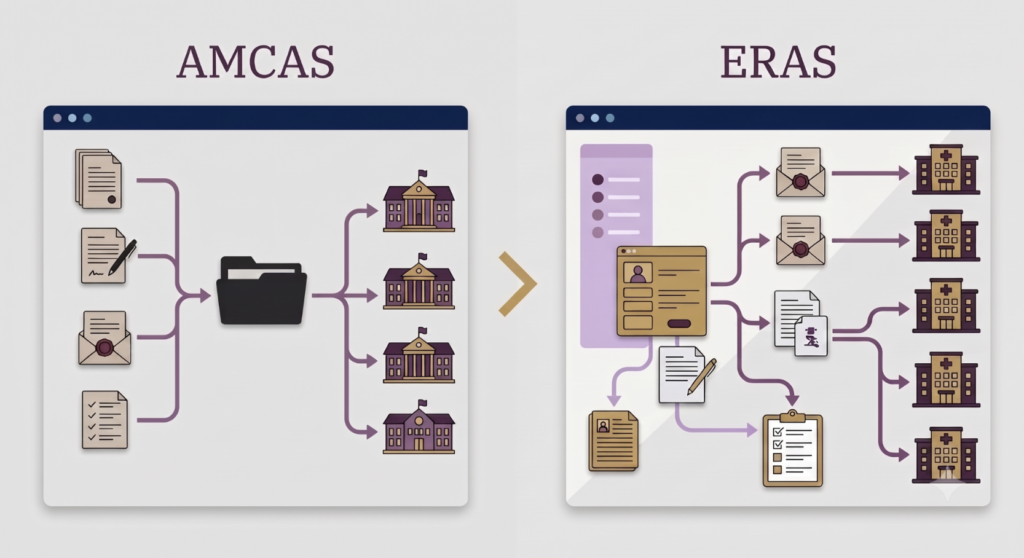
Unlike medical school admissions, where schools independently offer acceptances, residency applications use the Match process. You and programs submit rank lists, and the matching algorithm determines where you will train based on mutual preferences.
In addition, the residency application timeline is much shorter and more structured than medical school admissions. Unlike the medical school application process where you complete primary applications, secondary applications, and interviews over the course of a year, residency applicants complete ERAS submissions, interviews, rank list, and the NRMP match with a defined timeline of 7 months.
Your Personal Statement Has a New Purpose
A MD/DO’s personal statement focuses on one important question: “Why do you want to become a doctor?” A strong residency personal statement answers a different question: “why do you want to pursue the specialty that you have chosen, and why should programs choose you? While MD/DO’s personal statement may be about experiences at any stage of your life, a residency personal statement should primarily focus on your medical school experiences, unless your focus in your chosen specialty began before medical school and played a significant role in your decision to pursue it.
Rather than discussing your journey into medicine, residency programs want to understand how your experiences in medical school have shaped your specialty choice, what you have learned throughout medical school, and how your goals align with their program. A strong residency personal statement demonstrates maturity, self-reflection, and a clear understanding of the specialty you want to pursue.

The personal statement requirements also differ between medical school and residency applications. Medical school personal statements are limited to 5,300 characters, while residency personal statements through ERAS have a much higher character limit of 28,000, though you should focus on clarity and conciseness rather than maximizing the available space and aim for 3,500–5,200 characters.
Choosing Experiences That Strengthen Your Specialty Application
Medical School applicants often participate in a wide variety of volunteer work, research, leadership positions, and extracurricular activities to demonstrate your interests and commitment to medicine. The way you present your experience also differs between AMCAS and ERAS. Medical school applications allow up to 15 experiences, while residency applications allow up to 10. In both applications, you can designate up to three experiences as Most Meaningful.
For Residency, the focus becomes much more intentional. Clinical rotations, sub-interships, electives, research projects, leadership experiences, and volunteer activities should reinforce your commitment to your chosen specialty. Residency Programs want to see consistent involvement in meaningful experiences to demonstrate your readiness for specialty training.
Application Strategy is More than Just Applying Broadly
Unlike medical school applications, which require applying to a multitude of schools within your stats range, residency applications require deeper planning and research.
Students must consider factors such as specialty competitiveness, geographic preference, program size, research opportunities, program culture, Step 1 and 2’s score, and personal career goals. Developing a thoughtful application list can improve your chances of getting interviews while ensuring you apply to programs that are a good fit. Those applying to residency may be comforted to know that you won’t have to write the secondaries required of Medical school applications. Instead, USMLE Step 1 and Step 2 scores become important factors in determining an applicant’s competitiveness for specific residency programs.
The number of applications also differs between the two processes. As a medical school applicant, you will typically apply to 15 to 20 schools, while as residency applicant, you will often apply to 50 to 60+ programs depending on your specialty, competitiveness, and application strategy.
You should prepare for your application early by refining your CV, updating experiences, requesting letters of recommendation in advance, and practicing common interview questions. A well-planned application often leads to greater confidence AND greater success throughout the process.
Common Mistakes Applicants Can Avoid
Many residency applicants make avoidable mistakes simply because they underestimate how different the process is from applying to medical school.
Some of the common mistakes include:
- Waiting too long to request letters of recommendation
- Writing a generic personal statement that could apply to any specialty, since ERAS allows applicants to create unlimited personal statements and assign a specific one to specific programs, depending on the program
- Failing to update experiences and accomplishments throughout medical school
- Applying without a clear strategy based on competitiveness and program fit
- Beginning interview preparation too late

Starting early with our Residency Packages gives applicants the time and direct guidance to build a stronger application while avoiding unnecessary stress during one of the busiest periods of medical school.
Bottom Line
Although these application processes share similar components, residency applications require a more specialized and strategic approach. While medical school admissions emphasize your potential as a future physician, residency programs evaluate how your clinical experiences, specialty interests, and professional goals prepare you for specialty training. Understanding these differences early allows you to build a stronger, more competitive application. Check out our blog if you are interested in learning more about Residency Interviews.
Our newly launched Residency Packages are designed to help those applying to residency at every stage of the residency application process. From personal statement strategizing to editing and ERAS application guidance to interview preparation, Medical Muse provides live sessions and personalized support to help you present your strongest application with confidence. Our clients work directly with Dr. Ganguly and receive feedback tailored to their application.
The residency application process begins long before you submit your application. Start preparing today so you are ready to put your best application forward when the due date arrives. Medical Muse is here to help you throughout your journey. Schedule a consultation call with Dr. Ganguly to learn more about our Residency Packages!