Published by Medical Muse, a boutique admissions consulting firm that offers personalized support to help medical school and residency applicants successfully navigate the increasingly competitive admissions landscape.
Deciding whether to include pre-med experiences on ERAS is a common question medical students face when assembling their residency application portfolio. With the Electronic Residency Application Service (ERAS) limiting candidates to 10 total experience entries, every area must work strategically to highlight who you are as a future clinician.
While residency program directors primarily evaluate your growth during medical school, high-impact achievements from your undergraduate years can still provide a distinct competitive edge. Knowing how to filter your past achievements ensures your application stands out and that each entry contributes meaningfully to your narrative.
Should I include this activity? Here our advice:
| Experience Category | ERAS Value Impact | Our Recommendation | Example Activity |
| Prior Professional Careers | High Impact | Include: Demonstrates maturity and transferable skills. | Registered Nurse, Engineer, EMT, Teacher |
| Major Achievements | High Impact | Include: Highlights extraordinary leadership and grit. | Military service, NCAA athlete, Founding a non-profit |
| Scholarly Publications | High Impact | Include: Adds academic currency to your medical school experience section. | Peer-reviewed paper, National conference presentation |
| Longitudinal Commitments | Medium/High Impact | Include: Reinforces a continuous commitment throughout undergrad and medical school. | Multi-year tutoring or continuous community outreach that continued. |
| Uninvolved Club Memberships | Low Impact | Omit: Consumes space without showing leadership. | General pre-med society member |
| Short-Term Volunteering | Low Impact | Omit: Appears as superficial fluff to program directors. | Single-day 5K race or food bank shift |
When Should You Include Undergraduate Work on ERAS?
The Bottom Line:
Including pre-med experiences on ERAS is recommended when they demonstrate prior professional careers, rare national achievements, major published research, or multi-year longitudinal commitments. Because program directors prioritize your medical school growth, only keep undergraduate activities that display extraordinary leadership, commitment, talent, or otherwise distinguish you from other applicants.
The core rule of an effective ERAS residency application strategy is quality over quantity. According to the AAMC’s official guide to ERAS, applicants should focus on entries that best demonstrate personal growth and professional alignment. Because space is restricted, your pre-medical entries must meet a high threshold of significance to justify replacing a medical school milestone.
1. Significant Prior Careers
If you entered medical school after working full-time in another field, that experience belongs on your application. Roles as a nurse, software engineer, classroom teacher, or paramedic demonstrate real-world maturity, communication skills, and professionalism. If you are framing earlier professional achievements, the techniques outlined in our guide on 5 Strategies on How to Build a Competitive Pre-Med Resume
can help articulate those transferable skills.
2. High-Impact or Rare Achievements
Major milestones do not lose their value when you transition into medical school. Serving in the military, competing as an NCAA athlete, founding a non-profit, or earning a national fellowship showcases dedication and resilience. Data from the NRMP’s Program Director Survey indicates that leadership and unique non-academic experiences frequently distinguish applicants with similar academic metrics.
3. Major Scholarly Output
Undergraduate research that resulted in a peer-reviewed publication or a presentation at a national conference retains value. Academic achievement does not expire simply because it occurred before medical school; it can still be a strong asset for your residency experience section.
4. Longitudinal Commitments That Define Your Narrative
If your career narrative centers on a core passion, including medical education or advocacy, pre-med experiences can establish a long-standing pattern. For example, if you served as an organic chemistry tutor for three years in college and continued teaching in medical school, listing both demonstrates sustained dedication. Learn how to capture the value of your long-term commitments in writing by reading our blog, Elevating Your Medical School Journey: The Power of LinkedIn for Medical Students.

What Pre-Med Fluff Should You Omit from Your Application?
In Short:
You should leave basic undergraduate club memberships, short-term volunteer events, and general physician shadowing off your medical school experience section. These low-impact entries consume precious space among your 10 ERAS slots and distract program directors from your clinical clerkships and more recent accomplishments.
Pruning low-impact activities is essential to creating a clear, professional application. Including basic undergraduate items can inadvertently suggest a lack of substantive medical school achievements.
- Basic Club Memberships: Holding membership in a pre-med honor society without occupying an executive leadership role adds substance, but little value.
- One-Off Volunteer Events: Single-day activities, such as volunteering at a community run, appear superficial on a residency application.
- General Shadowing Hours: Your core clinical clerkships serve as your primary clinical foundation, rendering basic undergraduate shadowing redundant.
The golden rule remains clear: if an undergraduate experience heavily shaped your professional identity or sets you apart from other applicants, it earns a spot on your residency application.

Frequently Asked Questions
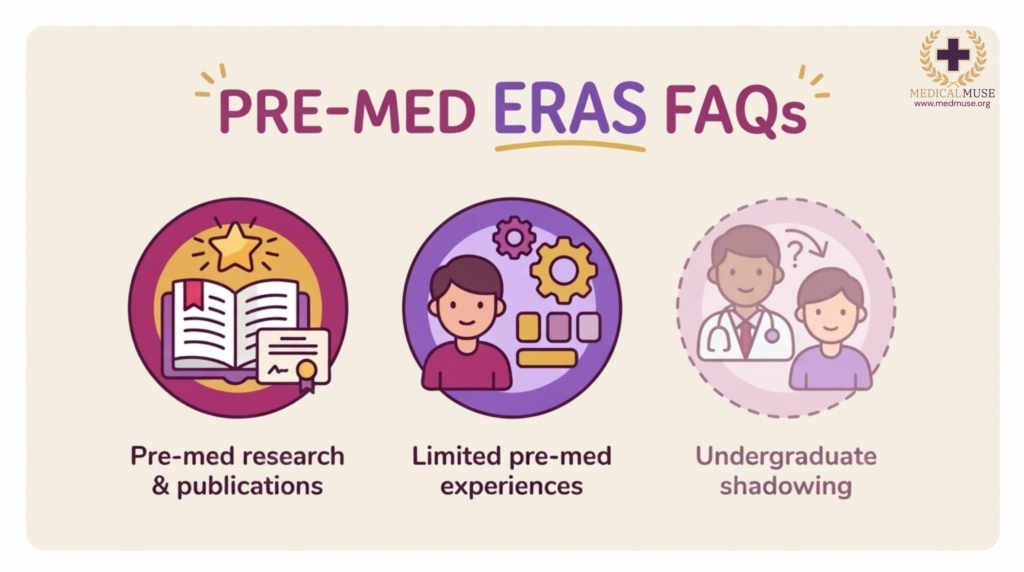
Can pre-med research publications count toward my ERAS experience limit?
Yes, peer-reviewed publications and national conference presentations from your pre-med years should be included. Scholarly output maintains academic value regardless of when it occurred, provided you can discuss the research accurately during residency interviews.
How many pre-med experiences are too many on an ERAS application?
Generally, pre-med experiences should occupy no more than 1 to 3 of your 10 total ERAS slots. Reserving the majority of your application for medical school achievements demonstrates to program directors that you have actively engaged in your core medical training.
Should I list undergraduate shadowing on ERAS if I lacked shadowing in medical school?
No, undergraduate shadowing should almost always be omitted. Clinical clerkships and sub-internships during medical school fulfill your clinical exposure requirements, making undergraduate shadowing unnecessary for residency program evaluation.