

Published by Medical Muse, a medical school admissions consulting company that offers personalized support to help medical school applicants successfully navigate the competitive admissions landscape
Table of Contents
Embracing Efficiency in Your Medical Journey
Ever feel like you’re constantly busy, but your application progress is moving at a snail’s pace? You are far from alone. Many aspiring physicians fall into the trap of treating every single task as equally urgent, scattering their energy across a vast landscape of endless to-dos.
One solution to this exhausting productivity puzzle is the 80/20 Rule, also known as the Pareto Principle. When adapted to the admissions journey, this concept can completely transform how you allocate your limited time, reducing emotional burnout while elevating your final application.
What is the 80/20 Rule for Pre-Meds?
The Takeaway:
The 80/20 Rule states that roughly 80% of your outcomes result from 20% of your inputs. For pre-med students, this means a select handful of high-impact activities—like maintaining an excellent GPA or securing meaningful clinical exposure—exert the greatest influence on your admission decisions.
This principle originated with economist Vilfredo Pareto, who noticed that 80% of wealth was held by 20% of the population. In the context of pre-medical preparation, it serves as a reminder that not all activities have an equal payoff.
If you are struggling to balance your coursework, MCAT preparation, clinical hours, and research, you must learn to identify your “vital few” priorities. Standing out to admissions committees requires moving away from superficial busywork and leaning heavily into high-yield tasks.

Evaluating Application Impact Matrix
To help you visualize how different activities stack up, consider this breakdown of common pre-med endeavors and their typical yield relative to your time investment:
| Pre-Med Activity Category | Typical Time Investment | Relative Application Impact | Primary Strategic Focus |
| Core Academic Foundation | High (20% of core effort) | High (80% of admissions weight) | MCAT prep and maintaining an upward science GPA trend. |
| Direct Patient Exposure | Medium | High | High-quality, hands-on clinical experience over passive shadowing hours. |
| Extracurricular Club Roles | High | Low to Medium | Avoid passive club memberships; prioritize leadership with tangible outcomes. |
| Scheduling/Logistics/Application Aesthetics | Low | Low to Medium | Basic medical school applicant time management and scheduling logistics. |
How to Leverage Pre-Med Productivity Strategies for Success
The Quick Answer:
Applying the 80/20 rule to pre-med life involves a systematic, three-step process: inventorying all responsibilities, isolating the high-impact clinical and academic activities that heavily sway admissions committees, and building your schedule to execute vital priorities first.
Implementing this workflow isn’t about working yourself to exhaustion. Instead, it is about shifting your mindset to ensure your daily work aligns with what medical programs genuinely value.
1. Execute a Strategic Responsibility Dump
Start by getting every single commitment out of your head and onto paper. Write out your current course loads, volunteering shifts, lab hours, and personal statement drafts. Do not worry about chronological order or perceived importance just yet; simply create a complete inventory of your weekly time expenditure.
2. Isolate Your Critical 20% Activities
This is where true analysis occurs. Look closely at your comprehensive list and separate your high-impact milestones from lower-yield commitments. To reveal your vital activities, ask yourself:
- Which of these commitments directly protects my science GPA or MCAT milestone?
- Which clinical exposures allow me to display the AAMC Core Competencies authentically?
- If I could only choose two achievements to speak about in an interview, what would they be?
The items that answer these questions constitute your critical 20%. These are often the most mentally demanding tasks, such as dedicated block testing for the MCAT or deep, reflective essay writing.
3. Protect Your High-Yield Focus Zones
Once your critical 20% is identified, dedicate your absolute best cognitive windows to them. Use structured methods like the Pomodoro Technique or strict time-blocking to guard these hours against interruption.
The remaining 80% of tasks, while necessary, can often occur together or be handled during lower-energy periods. Prioritizing requirements effectively means your success is measured by the progression of major milestones, not by how many minor items you crossed off a checklist.
Avoid the Dangerous Illusion of Pre-Med Busywork
In Short:
Pre-meds often succumb to the “busywork trap” because checking off simple, low-stakes tasks provides a false sense of accomplishment. True productivity requires focusing on the harder, high-yield application components that move the needle toward an acceptance.
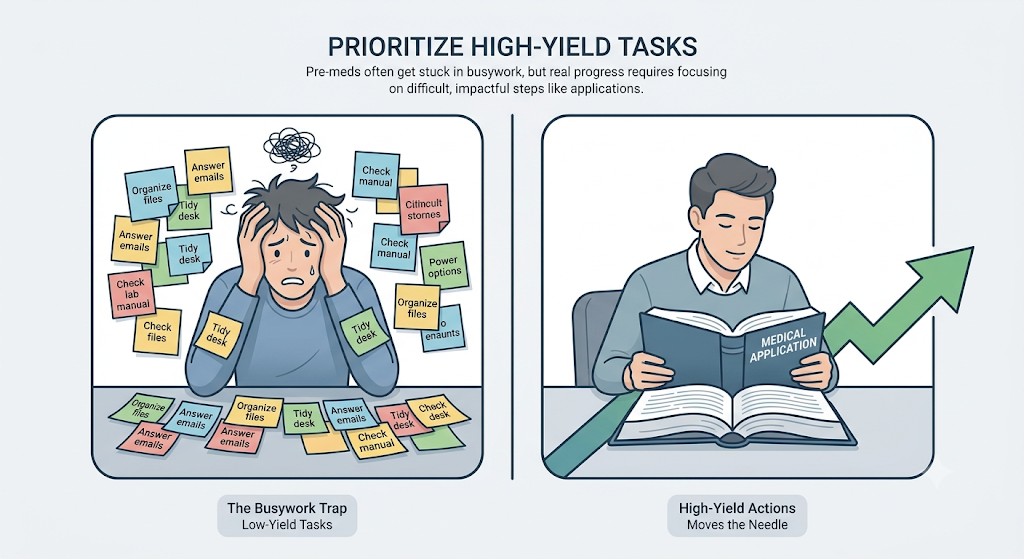
Without applying the 80/20 rule to pre-med life, it is incredibly easy to gravitate toward comfortable, passive tasks. Spending hours color-coding notes or attending casual club meetings feels productive and provides a quick boost of dopamine.
However, these activities rarely carry substantial weight when an admissions committee reviews your file. Admissions committees look closely at longitudinal commitment and core academic milestones, evaluating metrics outlined in official resources like the AACOMAS Applicant Guide. By choosing to operate within your high-yield zone, you ensure your time directly optimizes your acceptance odds, bringing much-needed balance to your everyday routine.
Identifying your personal high-impact focus area is often the hardest part of the process. If you want to know exactly where to direct your energy before applying, a Medical Muse Profile Gap Analysis can identify your core application weaknesses and provide a personalized strategic roadmap. By pinpointing the high-yield adjustments needed for your unique background, you can eliminate unnecessary tasks and ensure your remaining time directly moves the needle toward an acceptance.
Next Steps for Aspiring Medical Students
Maximizing your time is only the first step; aligning your efforts with a structured plan is what secures an acceptance. Whether you need periodic accountability or routine guidance to protect your focus zones, our seasonal and monthly advising clinics include a built-in Activity Tracker and expert milestone planning. Connect with Medical Muse today to explore our comprehensive medical school application packages and unlock a balanced path to admission.
Frequently Asked Questions
How can I apply the 80/20 rule if my undergraduate schedule feels completely inflexible?
Start small by analyzing your studying habits. Peer-reviewed studies in medical education journals highlight that active recall and spaced repetition are vastly superior to passive reading. Focus your limited open windows exclusively on these high-yield techniques to dramatically cut down your overall study hours while improving test performance.
Does emphasizing the 80/20 rule mean I should completely stop shadowing or volunteering?
Not at all. Nuance is essential here, as admissions processes are rarely completely black and white. Rather than quitting, use the principle to cap your time investment in passive observation once you have checked the necessary benchmarks, allowing you to reallocate hours to high-impact, hands-on clinical roles.
How do admissions committees view applicants who focus on fewer, deeper activities?
Admissions committees highly favor sustained depth and true commitment over a long list of involvements. Demonstrating impactful leadership or extensive patient care in two or three settings signals maturity and genuine purpose far better than brief participation in a dozen different clubs.