Published by Medical Muse, a medical school admissions consulting company that offers personalized support to help medical school applicants successfully navigate the competitive admissions landscape.
Table of Contents
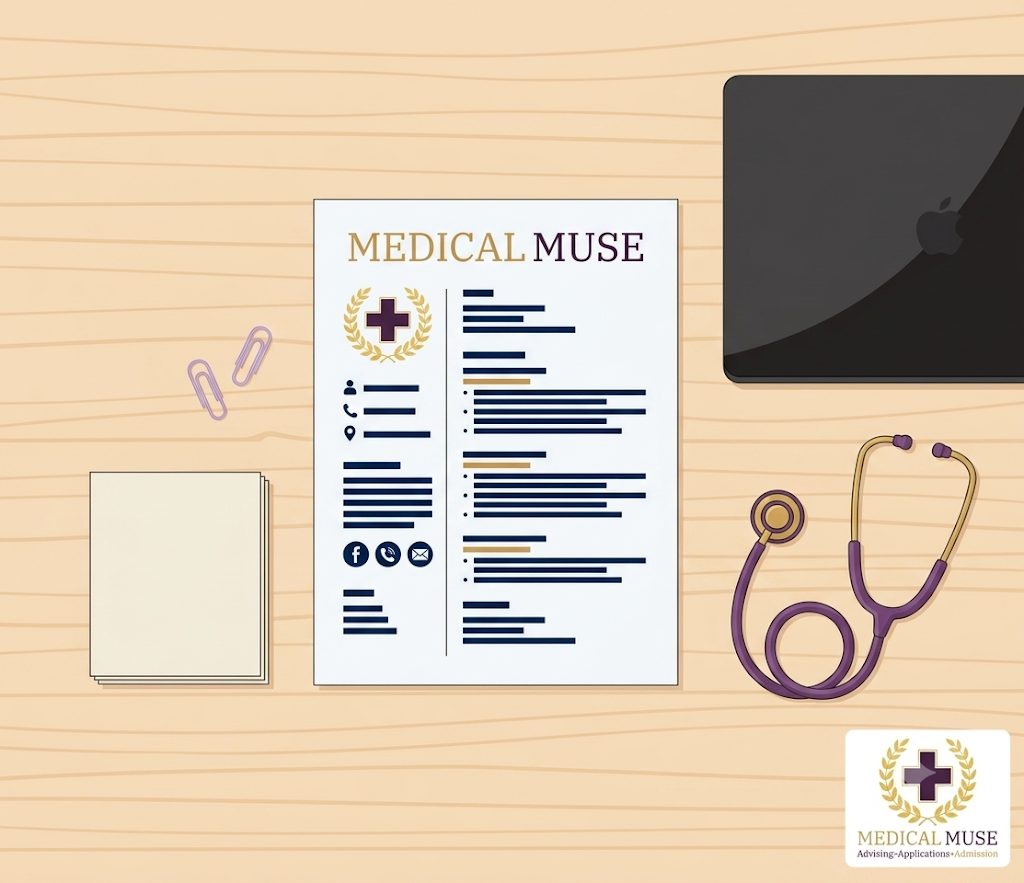
Preparing for medical school requires managing many demanding commitments simultaneously. Between reviewing MCAT material, maintaining a rigorous science course load, and securing clinical hours, it is easy to neglect your professional portfolio. However, learning how to build a competitive pre-med resume is an essential foundation for your medical school applications.
While a traditional curriculum vitae (CV) isn’t uploaded directly as a single document into primary application portals like AMCAS or AACOMAS, an organized resume serves as your blueprint. It helps you track your achievements, secure volunteer positions, and apply for research opportunities. A strong resume is an asset – use it to help you clearly articulate your path toward a career in medicine.
Aligning Your Activities with Your Professional Objectives
The Takeaway: To align your undergraduate activities effectively, target specific professional roles by customizing your resume format. Crafting specialized variations of your resume allows you to emphasize relevant skills, whether you are applying for an academic research grant or looking to secure clinical experience.
Many pre-med students mistakenly believe they should use a single, generic document for every opportunity. In reality, different healthcare and academic positions prioritize completely distinct skill sets. For instance, a principal investigator managing a laboratory wants to see your laboratory competencies and scientific coursework. Conversely, a supervisor hiring an emergency medical technician (EMT) looks for people skills and task management capabilities.
To stand out, you should develop multiple resume variations tailored to specific opportunities. Reflect deeply on your overarching narrative before drafting your descriptions. Identifying a central theme—such as community health advocacy, clinical innovation, or bench research—enables you to choose and frame your medical school application extracurriculars with clear intention. Ensuring these experiences reflect the traits outlined in the AAMC’s core competencies for entering medical students provides ad-coms with indicators of your professional readiness.
Balancing Active Involvement with Academic Excellence
The Quick Answer: Prioritizing a high undergraduate GPA is essential because academic performance serves as the primary screening metric for medical school admissions. Avoid overcommitting to extracurricular responsibilities if they compromise your performance in core science courses.
It is easy to get swept up in the pursuit of clinical hours and forget that your academic record forms the base of your medical school application. Admissions committees utilize undergraduate GPAs and MCAT scores as initial screening tools to ensure applicants can handle the rigorous medical school curriculum. Accumulating hundreds of volunteer hours will rarely compensate for a severely damaged science GPA, as demonstrated in historical metrics within the AAMC’s medical school applicant and matriculant data reports.
To manage this balance, create an academic plan that distributes your course load. Avoid overloading a single semester with multiple demanding laboratory classes and intensive clinical shifts. By mapping out your commitments on a clear timeline, you can protect your study hours while steadily building the achievements needed for your portfolio.
The following table provides a strategic breakdown of how to structure and prioritize different resume elements based on your year in school:
| Year | Core Resume Focus | Target Extracurricular Mix | Recommended Action |
| Freshman | Academic Foundation & GPA | 80% Coursework, 20% Clubs + Activities | Begin building your resume and establish positive study habits. |
| Sophomore | Foundational Clinical Exposure | 60% Coursework, 40% Shadowing + Volunteering | Secure initial clinical experience on resume. Maintain a strong academic record. |
| Junior | Leadership & Research | 50% Coursework, 50% Higher-Impact Roles: Org. Leadership, Teaching Assistant (TA), Independent Research | Strengthen extracurricular involvement (+ study for the MCAT). |
| Senior / Gap | Clinical/ Research & Interests | 30% Coursework 70% Clinical/Research Role(s) | Finalize your narrative for primary applications. Use this time to add something unique to your application. |
Mastering the Fundamentals of Effective Editing
In Short: Master the fundamentals of editing by utilizing strong action verbs, maintaining a scannable single-page layout, and adhering to standard formatting conventions. Eliminating passive voice and distracting visual design elements ensures that adcoms can quickly evaluate your qualifications.
When reviewing your professional background, admissions committees and clinical coordinators value clarity and conciseness above all else. Avoid dense, wordy blocks of prose that hide your actual achievements. Instead, start every descriptive bullet point with a dynamic action verb that highlights your direct impact and personal responsibility within that role.

Additionally, preserve a clean and organized layout by selecting standard professional fonts, maintaining uniform margins, and capping your document length at one page. Avoid incorporating complex graphic elements, progress bars, or headshots, as these can disrupt automated applicant tracking systems. Reviewing institutional formatting advice, such as the guidelines in the Harvard College Guide to Resumes & Cover Letters, can be a useful step. Utilizing a template can streamline the formatting process, allowing you to focus your energy on refining your content.
Finalizing Your Pre-Med Professional Portfolio
Crafting a compelling resume involves much more than compiling a list of past experiences; it is the process of translating your daily hard work into a narrative of professional readiness. Every clinical shift, volunteer project, and academic honor helps demonstrate your dedication to patient care and scientific inquiry.
As you progress through your education, update your resume entries regularly to reflect your growing experience. Utilizing a structured resource like the Medical Muse Seasonal or Monthly Advising Clinics can help you build your profile, providing a built-in Activity Tracker and regular milestone planning to ensure your extracurricular portfolio is competitive come application season.
Frequently Asked Questions
How long should a pre-med resume be for medical school?
A pre-med resume should strictly be kept to one single page. Adcoms review hundreds of profiles daily and favor concise, high-density documents. Limit your content to your most impactful academic honors, clinical experiences, and leadership roles, ensuring every entry directly supports your readiness for a career in medicine.
Should I include non-medical employment on my pre-med resume?
Yes, including non-medical employment is highly beneficial if it demonstrates transferable core competencies such as leadership, teamwork, or problem-solving. Working as a retail manager, customer service representative, or undergraduate tutor proves your reliability, work ethic, and ability to communicate effectively with diverse groups of people.
How do I list ongoing clinical hours that are not yet completed?
To list ongoing activities, indicate the start date followed by “Present” in the date section of your resume. Within the description bullet points, use present-tense action verbs for current duties and clearly state your projected total hours or anticipated completion timeline to provide full transparency to reviewers.