Published by Medical Muse, a boutique admissions consulting firm that offers personalized support to help medical school and residency applicants successfully navigate the increasingly competitive admissions landscape.
Facing high-stakes milestones when applying to medical school can bring capable applicants to a standstill. When pressure mounts, anxiety rarely stems from a lack of capability. Instead, it arises from perfectionism, isolation, and the high emotional toll of the application process, as documented in a National Institutes of Health study on pre-med and medical student anxiety. By implementing healthy coping mechanisms and stress management tools. Overcoming medical school application overwhelm becomes a structured, manageable process that replaces burnout with momentum.
| Strategy Component | Core Objective | Primary Benefit |
| Objective Narrative Reframing | Shift focus from self-promotion to patient impact | Eliminates imposter syndrome and writer’s block |
| Rolling Workflow Systems | Limit active tasks to a 3 to 4 item queue | Prevents decision paralysis and cognitive fatigue |
| Live Co-Editing Sessions | Provide real-time feedback and progress | Directly aids in reducing anxiety and decision fatigue |
| Building your “Application Vibe” | Connect clinical experiences into a unified thesis | Builds a cohesive and memorable pre-med narrative strategy |
How Can High-Achievers Focus on Overcoming Medical School Application Overwhelm?
The Quick Answer: Overcoming medical school application overwhelm requires shifting from self-promotional anxiety to objective storytelling, breaking massive essay workloads into 3-day rolling sprints, and utilizing real-time live editing. Combining operational structure with empathetic support eliminates decision paralysis and restores steady progress.
Our expert, Dr. Christine Ganguly, the founder of Medical Muse, notes that staring at a blank page to sound impressive often triggers imposter syndrome. High-achievers frequently struggle with self-promotion because writing about personal accomplishments feels uncomfortable. To bypass this barrier, applicants must shift from self-evaluation to objective advocacy.
When writing personal statements or secondary essays, position yourself as an objective observer describing your clinical and community contributions. By refocusing on the individuals you serve—such as patients, mentees, or underserved populations—writing transforms from a self-assessment into a clear mission statement. For applicants seeking personalized guidance refining this narrative framing, Medical Muse’s Elite Personal Statement Package offers structured story-building and live co-editing sessions. Normalizing rough first drafts early in the cycle ensures that iterative editing, rather than instant perfection, drives narrative success. For more tips on optimizing your limited time, read our breakdown on 3 Ways Applying the 80/20 Rule to Pre-Med Life Can Supercharge Your Application.
What Is the Ideal Medical School Application Workflow for Peak Efficiency?
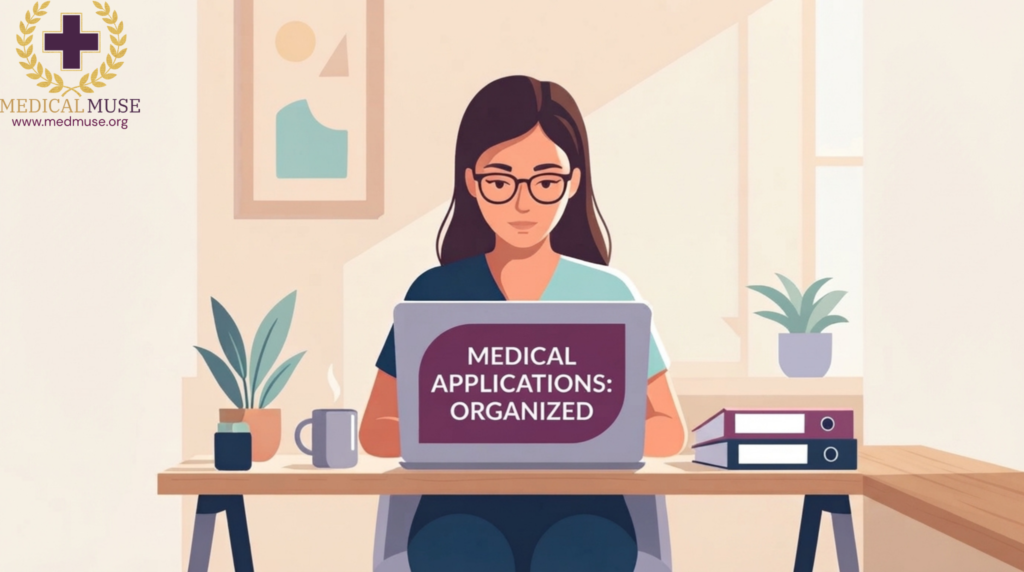
The Bottom Line: An efficient medical school application workflow relies on a 3-day turnaround rule and a capped queue of 3 to 4 active tasks. Restricting active items prevents cognitive burnout, while building core backbone essays allows applicants to seamlessly adapt materials across dozens of secondary prompts.
Attempting to address 15 to 20 secondary essay prompts simultaneously induces decision paralysis. Managing a high-volume workload requires clear operational boundaries to protect cognitive energy. Data from the AAMC Facts report on applicant numbers shows that applicants apply to an average of 18 to 20 medical schools, resulting in over 40 individual essays. Following a structured timeline, like the one outlined in AAMC’s guide on managing application timelines, can help prevent burnout.
| Workflow Metric | Traditional Unstructured Approach | The Medical Muse Method | Strategic Impact for the Applicant |
| Active Task Capacity | 12–16 essays managed at once | To-do list queue capped at 3–4 items | Eliminates decision paralysis and mental fatigue. |
| Pace of Given Feedback | Unpredictable (2–3 weeks of stagnation) | Strict 3-day (72-hour) turnaround window | Prevents overthinking and maintains drafting momentum. |
| Content Scalability | Writing every secondary essay from scratch | Core “backbone” material adaptation | Cuts total drafting time by up to 50%. |
| Review Environment | Solitary writing and isolated editing | Real-time live co-editing sessions | Directly helps in reducing pre-med anxiety. |
Establishing core “backbone” essays allows applicants to construct flexible material that can be adapted for multiple prompts. Broad themes like personal resilience, diversity, and clinical insights serve as strong foundations for secondary requirements, reducing redundant effort. Detailed prewriting strategies are also covered in our guide on The Ultimate Guide to Prewriting for Medical School Applications.
How Does Live Co-Editing Support Reducing Pre-Med Anxiety?
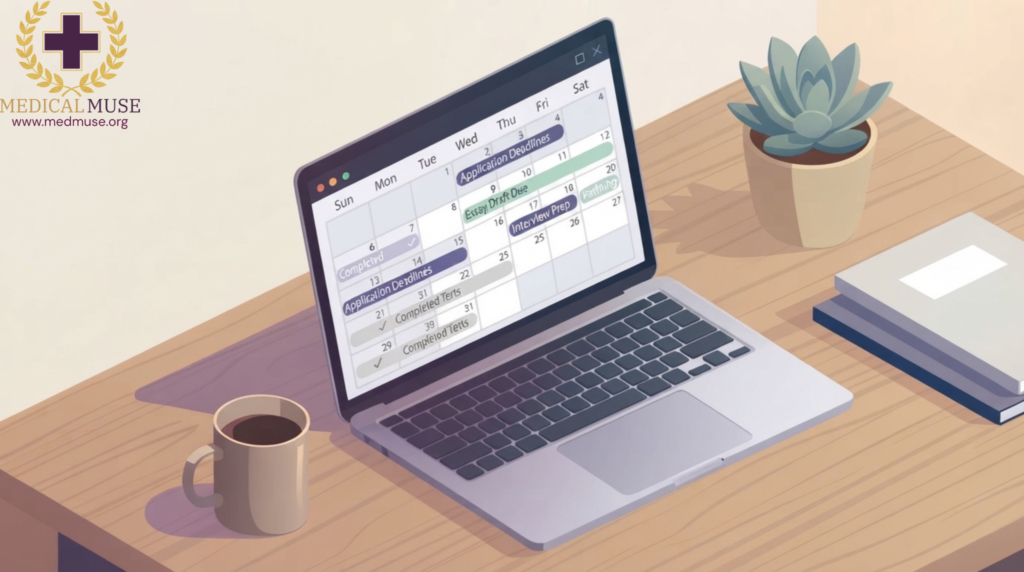
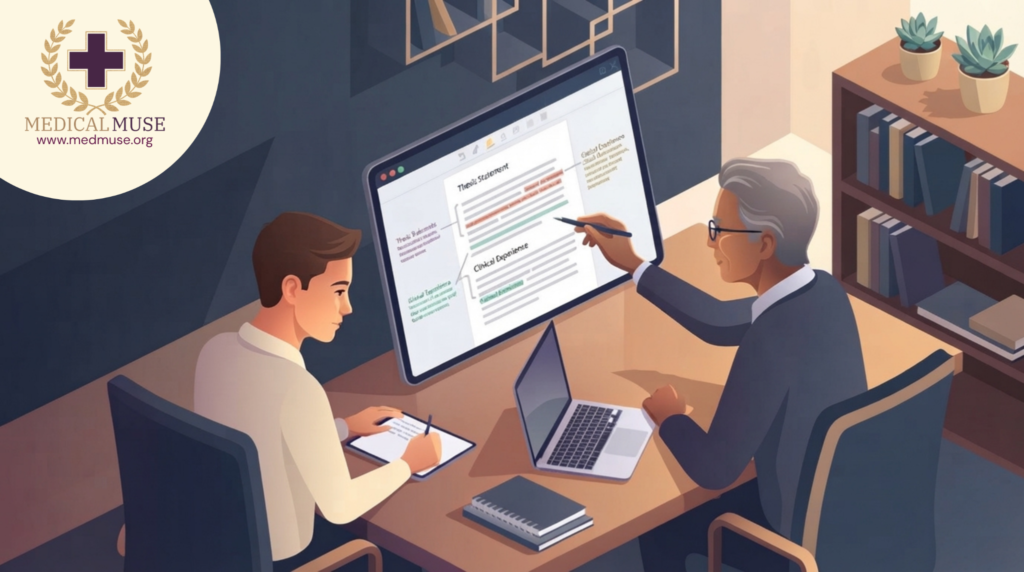
In Short: Live co-editing offers a dedicated time to receive feedback, allowing students to work directly alongside Dr. Ganguly to trim character counts, polish transitions, and resolve creative blocks. This collaborative environment eliminates the isolation of drafting alone and accelerates narrative clarity.
Asynchronous feedback is valuable, but sitting alone with critical notes often causes unnecessary stress. Live co-editing sessions bridge this gap by providing direct collaboration. Working through character limits and sentence transitions together transforms an intimidating writing process into a shared problem-solving session. To explore broader stress reduction techniques during the admissions process, see our guide: 4 Proven Strategies on How to Avoid Burnout as a Pre-Med and Stay Motivated.
Beyond technical editing, real-time collaboration helps extract your underlying personal philosophy. High-achievers often list activities chronologically rather than weaving them into a cohesive trajectory. Developing a clear pre-med narrative strategy—centered on core values like patient advocacy or community health—ensures every essay reflects your authentic commitment to medicine. Students seeking comprehensive support ahead of the application cycle can use Medical Muse’s Seasonal and Monthly Advising Clinics to remain accountable ahead of the application cycle.
Navigating high-stakes admissions milestones does not have to be a solitary burden. Schedule a consultation with Medical Muse today to turn application pressure into calm, actionable momentum.
Frequently Asked Questions
How many essays should I work on simultaneously?
To prevent cognitive overload, cap your active writing queue at 3 or 4 essays at a time. Focusing on a small batch allows you to maintain high writing quality, execute 3-day turnaround cycles, and avoid the paralysis associated with drafting potentially dozens of essays at once.
How does establishing core backbone content save drafting time?
Core backbone content consists of highly polished, foundational essays covering primary themes like diversity, challenge, and clinical growth. Because most medical schools ask similar secondary questions, adapting these core essays reduces repetitive drafting work by up to 50% across application cycles.
Why is live co-editing more effective than asynchronous essay notes?
Live co-editing provides immediate clarification, allowing you to fix structural issues, character limits, and awkward phrasing in real time. During these highly productive sessions, instant feedback stops second-guessing before it begins.